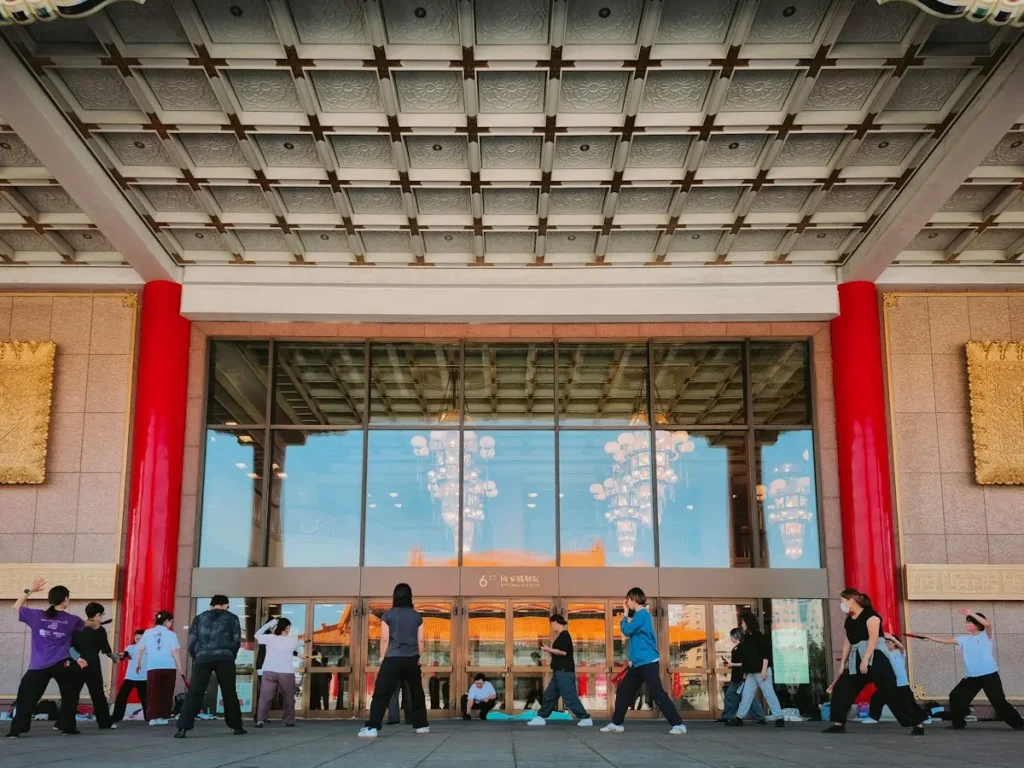
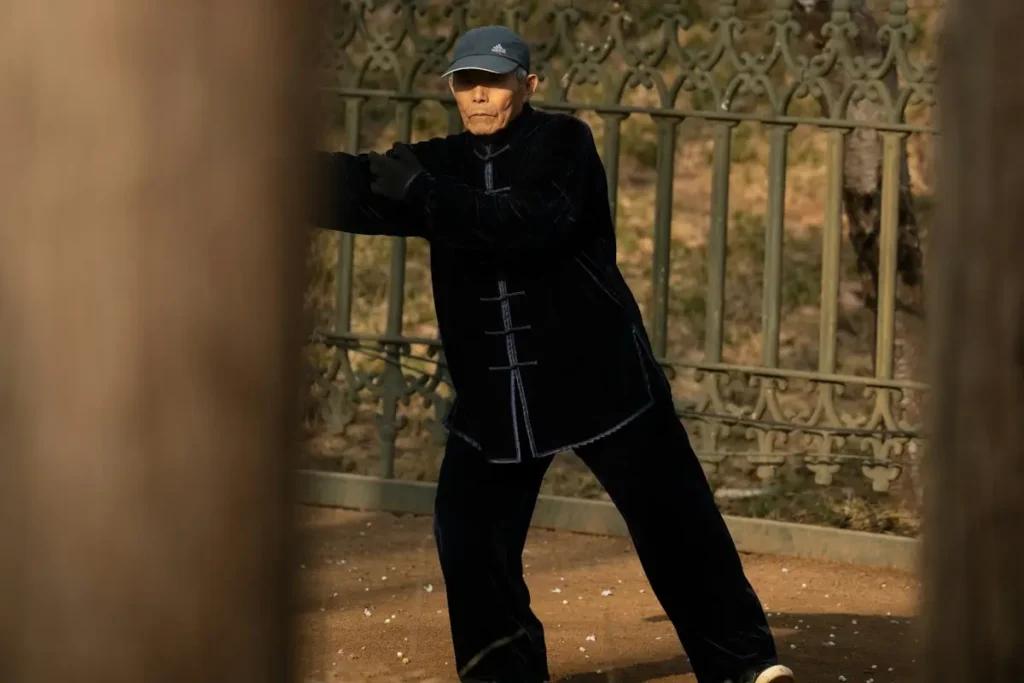
This ten-minute sequence introduces slow movement, comfortable breathing and gentle weight shifts. It is an illustrative practice routine, not the specific program tested in the studies below. Practise at a time that suits you, with food and support as needed; a morning fast is not required.
At a glance: a gentle introduction
- Use clear, non-slip floor space and stable footwear; keep a secure support nearby if needed.
- Knees soft, spine long, shoulders relaxed, breathing slow through the nose.
- Move slowly and continuously – speed is the most common mistake.
- Practise next to a chair or counter if your balance is unsure.
- Aim for 5 mornings a week for 8 weeks.
Before you start: posture and breathing
Stand with your feet about hip-width apart, toes pointing forward. Bend your knees slightly so they are “soft”, not locked. Imagine a thread gently lifting the crown of your head, so your spine lengthens. Let your shoulders drop and your arms hang loosely. Tuck your chin slightly.
Breathe in slowly through your nose, letting your belly expand, and breathe out a little more slowly than you breathed in. Throughout the routine, let movement follow the breath: arms rise or open as you breathe in, sink or close as you breathe out.
The 10-minute routine
| Part | Time |
|---|---|
| 1. Standing posture and breathing | 1 min |
| 2. Warm-up | 2 min |
| 3. Commencement | 1 min |
| 4. Weight shifting | 1 min |
| 5. Parting the wild horse’s mane | 1.5 min |
| 6. Wave hands like clouds | 1.5 min |
| 7. Brush knee | 1 min |
| 8. Closing | 1 min |
1. Standing posture and breathing (1 min)
- Take the posture described above.
- Keep your eyes open and look comfortably ahead.
- Take 6–8 slow breaths, feeling your weight evenly spread through both feet.
Tip: notice whether your weight drifts to your toes or heels and gently bring it back to the middle.
2. Warm-up (2 min)
- Roll your shoulders backwards 5 times, then forwards 5 times.
- With hands on your hips, make slow circles with your hips, 5 in each direction.
- Turn your upper body gently left and right, letting your arms swing loosely, 10 times.
- Lift one heel then the other, like slow walking on the spot, for 30 seconds.
Tip: keep everything relaxed – this is about loosening, not stretching hard.
3. Commencement (opening) (1 min)
- From the standing posture, breathe in and slowly float both arms up in front of you to shoulder height, palms facing down.
- Breathe out, bend your knees slightly and let your hands sink to hip height, as if pressing gently on water.
- Repeat 4–6 times.
Tip: the arms move because the body rises and sinks – don’t lift with your shoulders.
4. Weight shifting (1 min)
- Step your feet a little wider than hip-width.
- Shift a comfortable amount of weight toward your right leg while keeping both feet flat and a support within reach.
- Shift slowly across to the left leg. Pause.
- Repeat 6–8 times on each side.
Tip: this is the foundation of every tai chi movement. Hold a counter lightly if needed.
5. Parting the wild horse’s mane (1.5 min)
- Shift your weight to your right leg and bring your hands in front of your chest as if holding a large ball, right hand on top.
- Step forward with your left foot, heel first, and slowly transfer your weight onto it.
- As you shift forward, let your left arm rise diagonally in front of you to shoulder height while your right hand sinks beside your right hip.
- Shift your weight back, “hold the ball” on the other side and repeat with the right foot forward.
- Do 4–6 repetitions per side.
Tip: take small steps at first; width matters more than length for stability.
6. Wave hands like clouds (1.5 min)
- Stand with feet a little wider than your hips, knees soft.
- Raise your right hand in front of your face, palm facing you, and your left hand in front of your belly.
- Turn your waist slowly to the right, then shift weight to the left as you swap hand positions and turn to the left.
- Continue the slow, flowing side-to-side movement, eyes following the upper hand.
- Do 6–8 turns each way.
Tip: turn from the waist, not just the arms; keep your knees pointing forward.
7. Brush knee (1 min)
- Step forward with your left foot.
- As your weight moves forward, your left hand sweeps gently past your left knee and your right hand pushes slowly forward at chest height.
- Shift back, switch sides and repeat with the right foot forward.
- Do 4 repetitions per side.
Tip: keep the push soft – imagine moving a curtain, not pushing a wall.
8. Closing (1 min)
- Bring your feet back to hip-width.
- Breathe in and float your arms out to the sides and up; breathe out and lower your hands slowly in front of your body.
- Finish with your hands resting on your lower belly for three slow breaths.
Tip: notice how your body and mind feel compared with the start.
The most common mistakes
- Moving too fast. If you can’t breathe slowly while doing it, slow down.
- Locked knees or deep knee bends. Keep knees soft and pointing in the same direction as your toes.
- Raised, tense shoulders. Check them every minute or so and let them drop.
- Holding your breath during balance moments.
- Comparing yourself to videos. Smaller, controlled movements are better than big, wobbly ones.
Fitting practice into your day
Choose a time when you feel comfortable and steady. You can practise before or after a meal according to your needs; there is no requirement to combine this routine with fasting. Read more in Intermittent Fasting 16:8: A Safe Beginner’s Guide and Tai Chi Benefits: What the Research Says.
Written instructions cannot show every detail of a movement. A qualified instructor or an appropriate beginner program can help you learn and adapt technique.
Practise safely: stand next to a chair or counter if your balance is unsure. Stop if you feel dizzy or have pain. If you have severe osteoporosis, recent surgery or a high risk of falls, ask your doctor or physiotherapist first.
What to do tomorrow
At a comfortable time, try the standing, gentle weight-shifting and closing sections with a secure support nearby. Start with a few minutes and add movements only when you feel ready; you do not need to progress every day.
Frequently asked questions
Can I learn tai chi at home?
Yes. A simple routine like ours is a good start; a few sessions with a local teacher help you check your technique.
How long does it take to learn tai chi?
You can learn a basic 10-minute routine in a few weeks; most studies show benefits after 8–12 weeks of regular practice.
Is tai chi safe for seniors?
It is one of the safest forms of exercise. Practise next to a chair if your balance is unsure and ask your doctor if you have a high fall risk.
Turn this into a habit in 30 days
The 30-Day Longevity Reset turns the research into 15 minutes a day: eating window, movement, strength and calm – one simple step at a time. Join the waitlist for first access and a founding-member price.
Sources
- Lomas-Vega R et al. Tai chi for risk of falls: a meta-analysis. J Am Geriatr Soc, 2017. PubMed
- Huang ZG et al. Systematic review and meta-analysis: Tai Chi for preventing falls in older adults. BMJ Open, 2017. PubMed
- Wang C et al. Comparative effectiveness of tai chi versus physical therapy for knee osteoarthritis: a randomized trial. Ann Intern Med, 2016. PubMed
This article is for education only and is not medical advice. Read our medical disclaimer.