
Strength training helps you stay capable as you age: getting out of a chair, carrying shopping and moving with confidence. You can start at home with simple movements and a manageable routine. The plan below is an example to adapt to your fitness, recovery and health, rather than a deadline you must meet.
At a glance: build strength you can use
- Muscle and strength decline from middle age unless you train them.
- 30–60 minutes of strength training per week is linked to lower risk of death from all causes, heart disease and cancer.
- Five movements cover the basics: squat, push, hinge, pull, carry/core.
- Progress slowly: a few more repetitions or a slightly harder variation every week.
- Eat enough protein to support the training.
Muscle is a longevity organ
We tend to think of muscle as something for athletes. In reality, skeletal muscle is the body’s largest store for glucose, a major regulator of metabolism, and the engine that keeps you mobile. From middle age, adults gradually lose muscle mass and – even faster – muscle strength and power. Sarcopenia is a clinical condition in which low strength is a key sign, with low muscle quantity or quality used to confirm the diagnosis. It is associated with falls and disability; ordinary age-related change alone does not establish a diagnosis.
The encouraging part: muscle responds to training at any age. Studies in people in their 70s, 80s and even 90s show clear gains in strength with progressive resistance exercise. Expert bodies such as the National Strength and Conditioning Association now recommend resistance training for essentially all older adults, adjusted to their abilities.
A meta-analysis of observational cohorts associated muscle-strengthening activity with lower risk of several major health outcomes. Some dose-response curves showed the strongest associations around 30–60 minutes per week. This does not prove causation or establish a maximum useful training time.
Five exercises you can do at home
Use a stable chair and clear floor space. Start with an easy variation and one practice set if you are new; build toward 2 sets of 8–12 controlled repetitions as tolerated. Rest enough to recover your technique and stop each set while you could still do a few good repetitions. The carry or plank uses time rather than repetitions.
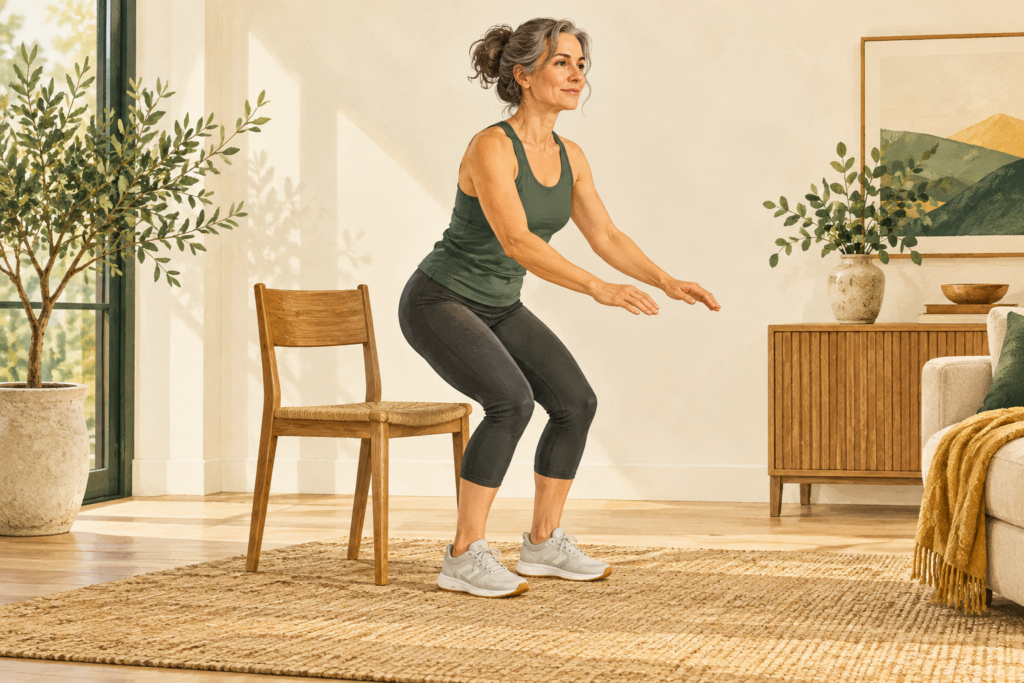
1. Squat to a chair
Stand in front of a chair, feet hip-width apart. Push your hips back and bend your knees to lightly touch the seat, then stand up by pushing through your whole foot. Keep your chest up and knees in line with your toes.
- Easier: sit fully down and stand up, using your hands on your thighs if needed.
- Harder: hold a backpack or water bottles, or use a lower seat.
2. Push-up (wall, bench or floor)
Place your hands slightly wider than your shoulders, body in a straight line from head to heels. Lower your chest towards your hands, then press back up.
- Easier: push-ups against a wall or kitchen counter.
- Harder: push-ups on the floor from your knees or toes.
3. Glute bridge
Lie on your back, knees bent, feet flat. Squeeze your buttocks and lift your hips until your body forms a straight line from shoulders to knees. Pause, then lower slowly.
- Easier: smaller range of motion.
- Harder: single-leg bridge, or a backpack on your hips.
4. Row
For a band row, use a purpose-made anchor installed according to its instructions and check that it is secure. Alternatively, use a lightly loaded backpack for a supported row. Pull your elbow toward your ribs with control; choose a load and position you can manage comfortably.
- Easier: light band, standing upright.
- Harder: heavier band or backpack, bent-over position with a flat back.
5. Carry or plank
Walk for 30–60 seconds holding two heavy shopping bags or water bottles, standing tall – or hold a plank on your forearms with a straight body.
- Easier: shorter carries, or a plank against a table.
- Harder: heavier load or longer hold.
How to progress with control
- Technique before weight. Slow, controlled repetitions; no bouncing.
- Increase one thing at a time: repetitions first (from 8 up to 12), then a harder variation or more weight.
- Rule of two: when you can do 2 more repetitions than your target in the last set for two sessions in a row, make it harder.
- Mild muscle soreness is normal for a day or two. Sharp joint pain is not – stop and adjust.
- Rest at least one day between sessions that train the same muscles.
An adaptable 8-week example
| Weeks | Sessions per week | Sets × repetitions | Focus |
|---|---|---|---|
| 1–2 | 2 | 2 × 8–10 | Learn the movements, easiest variations |
| 3–4 | 2 | 2–3 × 10–12 | Add a set, slower lowering phase |
| 5–6 | 2–3 | 3 × 8–12 | Progress to harder variations or add weight |
| 7–8 | 3 | 3 × 8–12 | Keep progressing; add carries and single-leg work |
Treat the table as a menu for progression, not a requirement to increase every fortnight. Repeat a stage if you need more practice or recovery. Track a useful everyday task, such as chair stands or carrying groceries, and compare your own progress over time.
Eat for your muscles
Training and adequate nutrition work together. Include protein-containing foods across your meals; your total needs depend on body size, activity and health. Older-adult protein recommendations need individual adjustment, particularly with kidney disease, so discuss your needs with a clinician or dietitian. If you combine strength training with fasting, read Fasting After 50: How to Keep Your Muscle.
Check with your doctor first if you have heart disease, uncontrolled high blood pressure, recent surgery, a hernia, osteoporosis with fractures, or joint problems. A physiotherapist can adapt exercises to your needs.
What to do tomorrow
Do one round of the five exercises above: 10 chair squats, 10 wall push-ups, 10 glute bridges, 10 rows with a backpack and a 30-second carry. It takes about ten minutes. Write down how many you managed – that’s your baseline.
Related: The Minimum Effective Dose of Exercise for Longevity
Frequently asked questions
Is it too late to start strength training after 40?
No. Muscle responds to training at any age – studies show strength gains even in people in their 80s and 90s.
How often should I do strength training?
Two to three sessions a week of 20–30 minutes, covering legs, push, pull and core, is enough for most people.
Do I need weights or a gym?
No. Bodyweight exercises, a backpack and a resistance band are enough to start and progress for months.
Turn this into a habit in 30 days
The 30-Day Longevity Reset turns the research into 15 minutes a day: eating window, movement, strength and calm – one simple step at a time. Join the waitlist for first access and a founding-member price.
Sources
- Momma H et al. Muscle-strengthening activities are associated with lower risk and mortality in major non-communicable diseases. Br J Sports Med, 2022. PubMed
- Fragala MS et al. Resistance training for older adults: position statement from the National Strength and Conditioning Association. J Strength Cond Res, 2019. PubMed
- Cruz-Jentoft AJ et al. Sarcopenia: revised European consensus on definition and diagnosis. Age Ageing, 2019. PubMed
- Westcott WL. Resistance training is medicine: effects of strength training on health. Curr Sports Med Rep, 2012. PubMed
- Bauer J et al. Evidence-based recommendations for optimal dietary protein intake in older people (PROT-AGE). J Am Med Dir Assoc, 2013. PubMed
This article is for education only and is not medical advice. Read our medical disclaimer.