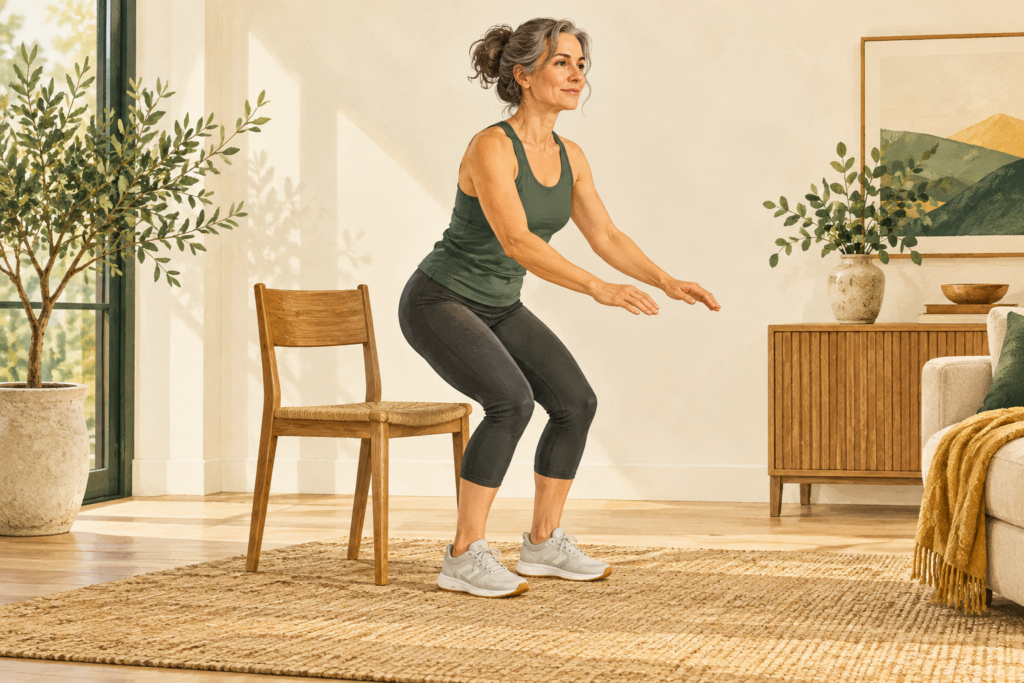

Some movement is better than none, and a useful routine can begin small. WHO guidance provides a weekly activity target; step-count studies and strength research offer additional context. These measures overlap, so you do not need to treat them as separate daily quotas. This guide helps you build a routine around your starting point.
At a glance: build a repeatable week
- Steps: benefits rise up to about 6,000–8,000/day after 60 and 8,000–10,000/day for younger adults.
- Strength: 30–60 minutes a week (two sessions) is linked to meaningfully lower mortality.
- Endurance: 150–300 minutes of moderate activity a week (WHO), or 75–150 minutes of vigorous.
- Balance: a few minutes most days, especially after 60.
- Short bursts count: even 1–2 minute stair climbs or brisk walks add up.
Why “minimum effective dose”?
Exercise advice often sounds like a second job. But the relationship between activity and health is steepest at the bottom: going from sedentary to lightly active brings the largest reduction in risk. After that, benefits keep growing, but more slowly. If you are busy, the goal is not to train like an athlete – it is to reliably hit the dose where most of the benefit lies.
The four ingredients
| Ingredient | Guidance or research context | What it protects |
|---|---|---|
| Steps / daily movement | Population associations vary by age; build from your baseline | Heart, metabolism, mood, mortality risk |
| Strength | 2 sessions, 30–60 min total | Muscle, bones, blood sugar, independence |
| Aerobic activity | 150 min moderate or 75 min vigorous | Heart and lungs, VO2max |
| Balance and mobility | Older adults: varied balance and strength activity on 3 or more days | Fall prevention, joints |
1. Steps: the foundation
A meta-analysis of 15 international studies found that people who took more steps per day had a lower risk of death, with benefits levelling off at about 6,000–8,000 steps for adults over 60 and 8,000–10,000 for younger adults. If you currently walk 3,000 steps, aiming for 10,000 tomorrow isn’t necessary – add 1,000 a day each week.
2. Strength: the most neglected
A large analysis of prospective studies linked 30–60 minutes per week of muscle-strengthening activity to a 10–20% lower risk of death from all causes, heart disease and cancer. These observational findings do not prove causation or set a maximum useful training time. Two manageable sessions can be a starting point, with duration and exercises adapted to your needs. See our guide to strength training after 40.
3. Endurance: fitness is a vital sign
In a study of over 120,000 people who completed treadmill tests, low cardiorespiratory fitness was associated with a far higher risk of death than high fitness – a difference comparable to well-known risk factors such as smoking and diabetes. The World Health Organization recommends 150–300 minutes of moderate activity or 75–150 minutes of vigorous activity per week. Brisk walking, cycling and swimming all count.
4. Balance: insurance for later
Choose balance practice appropriate to your ability, with a stable support nearby if needed. WHO recommends that older adults include varied multicomponent activity emphasizing balance and strength on at least three days a week. Tai chi is one possible approach.
Two simple markers to track: VO2max and grip strength
VO2max is the maximum amount of oxygen your body can use; it is the best single measure of aerobic fitness. Many sports watches estimate it – the absolute number is less important than whether it is rising or falling over time.
Grip strength is a surprisingly good predictor of health. In the international PURE study of nearly 140,000 adults, lower grip strength was linked to higher risk of death and cardiovascular disease. You can test it with an inexpensive hand dynamometer – or simply notice whether carrying shopping or opening jars is getting easier or harder.
Short bursts count
An analysis of wrist-worn activity trackers in more than 25,000 adults who did not exercise found that three or four bursts of vigorous everyday activity a day – each lasting about one minute, such as climbing stairs fast or carrying heavy bags – were associated with substantially lower mortality. This was observational evidence, not a trial prescribing fast stair climbs. Short activity bouts can count, but intensity should fit your health and current fitness.
An adaptable sample week
| Day | Activity |
|---|---|
| Monday | 20-min strength session at home + daily walk |
| Tuesday | 30-min brisk walk (Zone 2), take the stairs |
| Wednesday | 10-min tai chi or balance + 20-min walk after dinner |
| Thursday | 20-min strength session + daily walk |
| Friday | 30-min brisk walk or bike ride |
| Saturday | Longer activity you enjoy: hike, swim, cycle (45–60 min) |
| Sunday | Easy walk, stretching, rest |
Before you start: if you have heart disease, chest pain on exertion, uncontrolled blood pressure, diabetes with complications, or have been inactive for a long time and are over 50, talk to your doctor first. Increase intensity gradually.
What to do tomorrow
Check your average daily steps for last week on your phone. Add 1,000 to that number – that’s your new daily target. Choose a comfortable short walk or other activity you can repeat. Build duration gradually; vigorous stair climbing is not a required starting task.
Related: How to Age Slower: The 3 Pillars That Actually Work
Frequently asked questions
How many steps a day do I need?
Research suggests benefits level off around 6,000–8,000 steps a day for adults over 60 and 8,000–10,000 for younger adults.
Is 150 minutes of exercise a week enough?
It’s the WHO minimum for moderate activity and brings most of the benefit, especially when combined with two strength sessions a week.
Does walking count as exercise?
Yes. Brisk walking where you breathe harder but can still talk counts as moderate activity.
Turn this into a habit in 30 days
The 30-Day Longevity Reset turns the research into 15 minutes a day: eating window, movement, strength and calm – one simple step at a time. Join the waitlist for first access and a founding-member price.
Sources
- World Health Organization. Guidelines on physical activity and sedentary behaviour, 2020. WHO
- Paluch AE et al. Daily steps and all-cause mortality: a meta-analysis of 15 international cohorts. Lancet Public Health, 2022. PubMed
- Momma H et al. Muscle-strengthening activities are associated with lower risk and mortality in major non-communicable diseases. Br J Sports Med, 2022. PubMed
- Mandsager K et al. Association of cardiorespiratory fitness with long-term mortality among adults undergoing exercise treadmill testing. JAMA Netw Open, 2018. PubMed
- Leong DP et al. Prognostic value of grip strength: findings from the Prospective Urban Rural Epidemiology (PURE) study. Lancet, 2015. PubMed
- Stamatakis E et al. Association of wearable device-measured vigorous intermittent lifestyle physical activity with mortality. Nat Med, 2022. PubMed
This article is for education only and is not medical advice. Read our medical disclaimer.